.png)

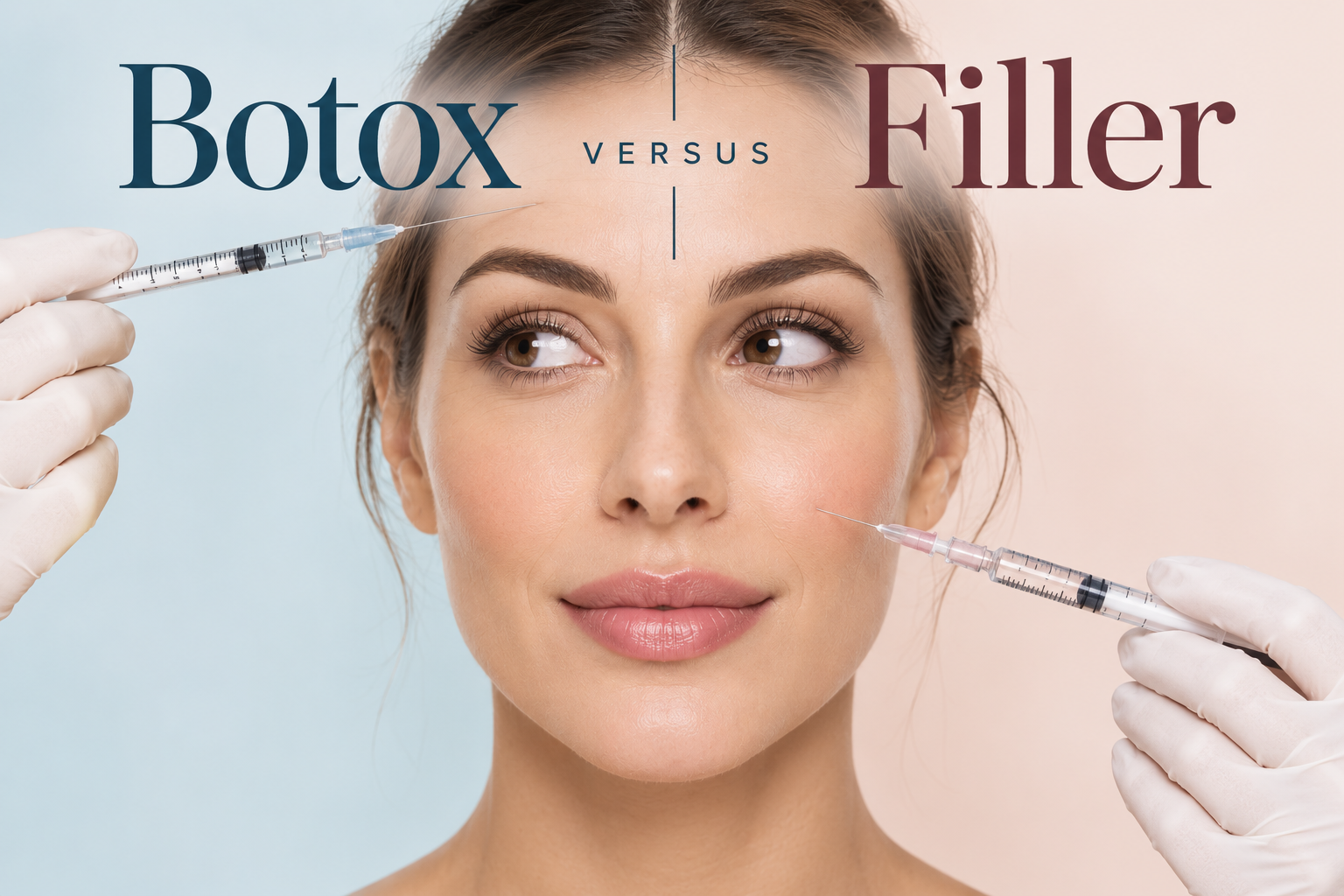
Botox vs. Filler
“Do I need Botox or filler?” is one of the most common questions I hear. They are often discussed together as injectable treatments, but they do very different things.
The simplest distinction is: Botox reduces targeted muscle movement. Filler adds or restores volume and structure.
That sounds straightforward,but deciding which treatment, if any, makes sense is more nuanced.
What Is Botox and How Does It Work?
Botox is a brand of botulinumtoxin type A, part of a category of injectable treatments called neuromodulators. Other brands include Dysport and Xeomin.
Neuromodulators temporarily reduce the nerve signals that cause selected muscles to contract. When those muscles move less forcefully, expression lines such as frown lines, forehead lines, and crow's feet can soften.
What Can Botox Treat?
Common cosmetic uses include:
● Frown lines between the brows
● Forehead lines
● Crow's feet around the eyes
● Selected lines around the nose and lower face
● Masseter treatment in appropriately selected patients
Neuromodulators also have medical uses, including treatment of conditions such as excessive sweating.
How Long Does Botox Last?
For many patients, the cosmetic effect lasts roughly three to four months, although duration varies with the area treated, dose, muscle strength, and individual response.
What Is Filler?
Fillers are injectable products used to add or restore volume, support, or contour. Hyaluronic acid is the most commonly used filler material in aesthetic practice, although other filler types also exist.
What Can Filler Treat?
Depending on a patient'sanatomy and goals, filler may be considered for areas such as:
● Cheeks or midface volume loss
● Lips
● Chin or jawline contour
● Selected facial hollows or folds
Some areas, particularly the under-eye region, require careful patient selection because filler is not always the best solution.
How Long Does Filler Last?
Duration varies substantially by product, treatment area, amount injected, and individual factors. Some hyaluronic acid fillers may last months, while others can remain considerably longer.
So Which One Do You Need?
A useful starting point is to ask what is causing the concern.
If a line is primarily created by repeated facial movement, a neuromodulator may help.
If the issue is true loss ofvolume or structural support, filler may be an option.
But a line that is visible at rest does not automatically mean it needs filler. Sometimes a laser, resurfacing treatment, skin-quality treatment, or simply doing nothing makes more sense.
Can You Get Botox and Filler Together?
Yes. Because they work indifferent ways, they can be used together when there is a clear reason to address both movement and volume.
The Bottom Line
For me, the goal of any injectable treatment is not to make someone look like a different person. Good treatment respects facial anatomy, preserves expression, and uses product conservatively. Sometimes that means saying no to more filler or deciding that an injectable is not the best tool for the concern.
The best place to start is not by deciding which syringe you want. It is by figuring out what is actually causing the change you are seeing and whether treating it will give you a result you genuinely want.
Individual results vary. This content is foreducational purposes and does not replace a personalized consultation with aqualified medical provider.
Featured Blogs